Best Medical Scalpel Blades: Top 10 Picks, Blade Types, Specs, Datasheets, And Pricing
This guide covers everything from scalpel blade types and numbers to scalpel blades to buy.
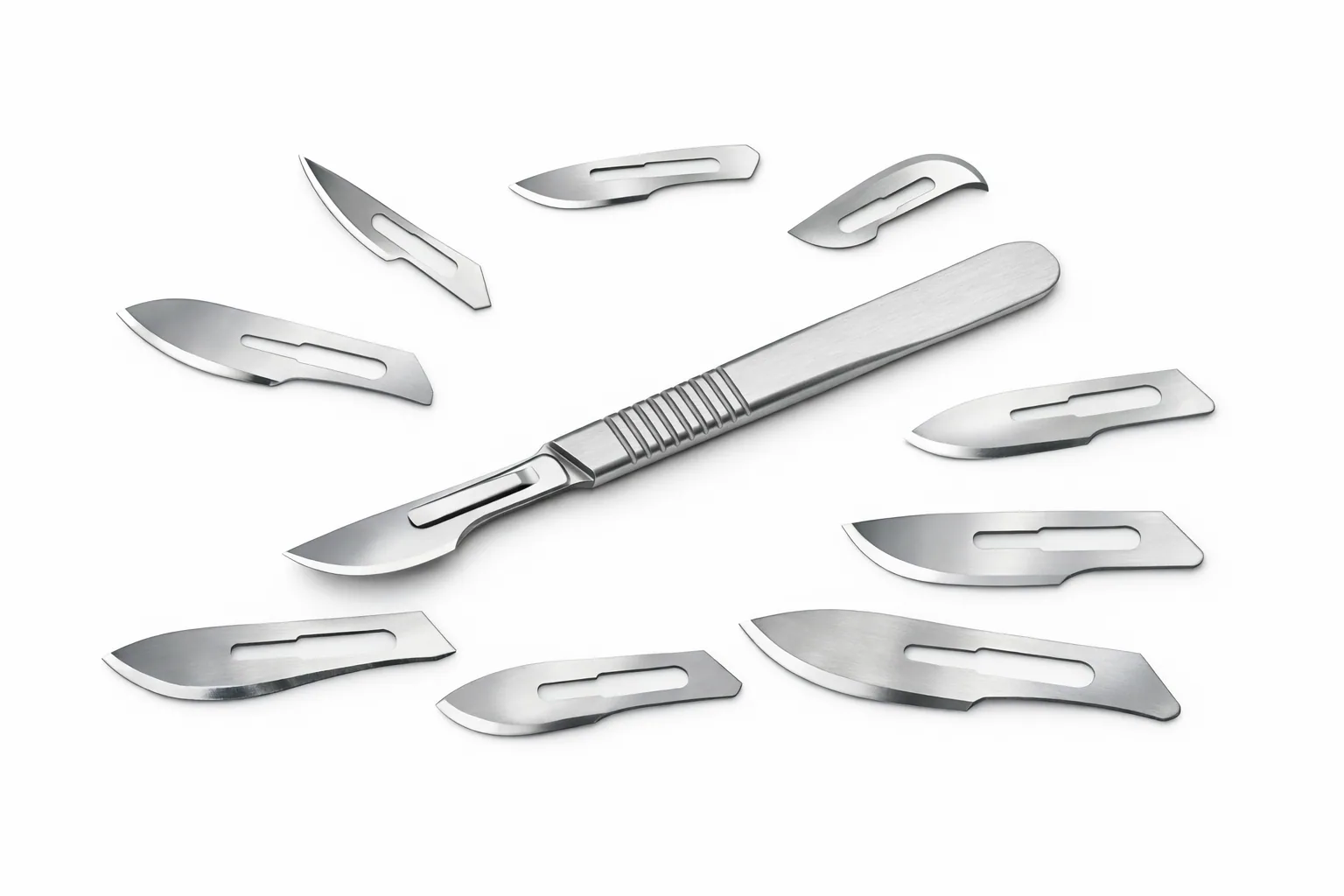
Choosing the right medical scalpel blades is about more than “sharp vs not sharp.” In real clinical workflows, the best blade is the one that reliably delivers the incision you need, fits your handles correctly, arrives sterile with packaging that supports safe passing and opening, and stays consistent across lots.
This guide covers:
Scalpel blade types and numbers (what to use and when)
Carbon steel vs stainless vs coated blades
Packaging and safety features that matter in practice
Top 10 scalpel blade picks with specs, datasheets, and typical pricing
A comparison table to simplify procurement
Medical devices and consumables change frequently across regions and distributors, so treat all pricing as “typical street pricing,” not a guaranteed quote.
Medical Scalpel Blade Types And Numbers
Most disposable scalpel blades follow standard “blade numbers” and pair with compatible handles. Here is a practical quick reference you can use for ordering and preference cards.
Common Blade Numbers And Typical Use Cases
Blade Number | Shape And Typical Use | Common Handle Family |
|---|---|---|
No. 10 | Curved belly for general skin and soft tissue incisions | Often paired with No. 3-style handles |
No. 11 | Triangular, sharp point for stab incisions, drainage, precise entry cuts | Often paired with No. 3-style handles |
No. 12 | Hooked tip, frequently used for suture removal and specialty incisions | Often paired with No. 3-style handles |
No. 15 | Smaller curved belly for short, precise incisions | Often paired with No. 3-style handles |
No. 20 | Larger curved blade for longer incisions | Often paired with No. 4-style handles |
No. 21–24 | Larger general-purpose shapes depending on preference and specialty | Often paired with No. 4-style handles |
No. 25 | Larger, broad cutting edge (varies by manufacturer’s line) | Often paired with No. 4-style handles |
Example: Swann-Morton’s No. 10 is positioned as a general incision blade and lists broad handle compatibility on its product page. (Swann-Morton)
Carbon Steel Vs Stainless Steel Vs Coated Blades
You will see these material choices across almost every major manufacturer line.
Carbon Steel Blades
Often chosen for edge retention during a procedure
Can be more prone to corrosion if improperly stored after packaging is compromised
Common in cost-effective sterile packs
McKesson’s own guidance (tear sheet) describes carbon steel as holding an edge longer, while stainless can feel sharper initially. (McKesson Image CDN)
Stainless Steel Blades
Strong all-round option for routine incision work
Typically chosen when facilities prioritize corrosion resistance and consistent handling
Widely available across blade sizes
Coated Blades
Often designed to reduce drag and improve incision smoothness
Especially popular in derm and plastics workflows where tissue handling and scar outcomes are closely watched
Miltex silicone-coated blades, for example, are explicitly marketed around smoother incision performance and reduced force versus standard carbon or stainless blades. (Delasco)
Sterility, Packaging, And Quality Standards
Scalpel blades are small, but the “hidden” procurement risks are usually not the edge. They are packaging integrity, handling safety, and lot-to-lot consistency.
What To Look For In Packaging
Individually wrapped (foil or peel pouch) for aseptic opening and safe passing
Inner liners that reduce accidental cuts during opening
Clear labeling for blade number and sterility
Bard-Parker and Feather listings commonly highlight foil pouch packaging and protective liners, which directly supports safer setup and passing. (Fisher Scientific)
Standards And Material Expectations
Manufacturers and suppliers often reference standards for blade construction, hardness, and composition. Exelint explicitly states conformance to ISO and British standards for blades on its product page. (EXELINT)
A surgical supplier resource also notes carbon and stainless blades must meet requirements around hardness and material composition (for example via BS and EN ISO materials standards). (CS Corp)
Best Medical Scalpel Blades
Top 10 Picks With Specs, Datasheets, And Typical Pricing
Each pick below includes:
What it’s best for
Key features that affect real-world use
A “datasheet trail” (manufacturer spec page, catalog, IFU, or equivalent)
Typical pricing from at least one distributor listing when available
1) Swann-Morton Sterile Surgical Scalpel Blades
Best For: General surgery workflows that want widely recognized blade geometry and broad availability
What These Blades Do Well
Swann-Morton is a common standard in many settings because the blade shapes and sizing are widely used and familiar. Their official blade pages spell out intended use and handle fit, which helps standardize preference cards.
Key Features And Specs
Available in common blade numbers (No. 10, 11, 15, and more, depending on line)
Sterile, individually packaged options available through distributors
Handle fit information is clearly published for specific blade numbers
Example: Swann-Morton’s No. 10 page describes typical use cases and lists compatible handles. (Swann-Morton)
Swann-Morton’s blade pages for other sizes include packaging codes and handle fit details that support procurement standardization.
Datasheet And Documentation
Manufacturer product pages by blade number (serves as a spec reference) (Swann-Morton)
Typical Pricing
US specialty medical suppliers often show around $50–$56 per box of 100 depending on material and blade size selection. (Delasco)
UK suppliers can show significantly different pricing (region and channel dependent). (Main Website)
Procurement Notes
If you are standardizing across multiple departments, choose a consistent material (carbon vs stainless) and lock in the blade numbers that match your most common trays.
2) Bard-Parker Conventional And Rib-Back Blades (Aspen Surgical)
Best For: Facilities that want a well-known blade system, plus options like rib-back designs and strong packaging practices
What These Blades Do Well
Bard-Parker remains a common choice in hospitals and procedural settings, in part due to consistent systemization across sizes and packaging designed to protect the user.
Key Features And Specs
Available in carbon and stainless steel options (line-dependent) (Aspen Surgical)
“Rib-back” blade designs are offered on select blades for control and strength (supplier descriptions highlight this feature) (Fisher Scientific)
Sterile configurations and clear technical specifications by part number on Aspen’s product pages (Aspen Surgical)
Packaging frequently described as foil pouch with protective liner for user safety (Fisher Scientific)
Datasheet And Documentation
Aspen Surgical product pages include technical specifications per part number (Aspen Surgical)
Supplier catalogs and brochures are commonly linked by distributors (HOSPEQ)
Typical Pricing
Pricing varies heavily by packaging unit (box vs case). Example: one listing shows a case price for rib-back blades (case quantity and price stated). (Vitality Medical)
Smaller pack pricing can be higher on a per-blade basis (example pack-of-10 listing). (Dental City)
Procurement Notes
Confirm whether your facility needs conventional blades only or wants “protected” or safety-style options that pair with the system.
3) Feather Surgical Blades (Feather Safety Razor)
Best For: Teams prioritizing extremely sharp, precision-oriented blades and consistent packaging
What These Blades Do Well
Feather is widely associated with very sharp edge production and a strong reputation for precision manufacturing. Their manufacturer page describes stainless and a non-glare carbon option and emphasizes individually packed sterile blades. (フェザー安全剃刀株式会社)
Key Features And Specs
Offered in stainless steel and carbon variants depending on line (フェザー安全剃刀株式会社)
Individually packaged sterile blades (common channel descriptions) (フェザー安全剃刀株式会社)
Distributor descriptions often emphasize protective packaging and liners (Graham-Field)
Datasheet And Documentation
Manufacturer product page functions as a spec reference (フェザー安全剃刀株式会社)
Graham-Field product page describes packaging and handling details (useful as a procurement reference) (Graham-Field)
Typical Pricing
Examples show a wide range depending on distributor and supply chain:
Around $35.95 per 100 on one medical supply listing (Medex Supply)
Around $72.05 per 100 on a lab and microscopy supplier listing (Electron Microscopy Sciences)
Discounted pricing can appear at other retailers (example listing shows a sale price) (PST Shop)
Procurement Notes
Feather pricing is highly channel-dependent. If you standardize Feather, negotiate a consistent contracted source to avoid unexpected per-box swings.
4) KAI Medical Sterile Surgical Blades
Best For: Clinics and dental or surgical settings that want Japanese-manufactured blades with clear sterile packaging norms
What These Blades Do Well
KAI is commonly positioned around clean manufacturing and consistent blade offerings. Practical buying often hinges on availability and preferred distributor channel.
Key Features And Specs
Sterile surgical blade instructions and handling documentation are available through KAI’s IFU documents (KAI MEDICAL |)
Distributor listings commonly specify sterile, individually packaged blades (configuration depends on vendor) (McKesson Medical-Surgical)
Datasheet And Documentation
KAI surgical blade IFU (serves as formal documentation for handling and use) (KAI MEDICAL |)
Typical Pricing
Example distributor pricing is available in local currency depending on region (for example, AU pricing for a box of 100). (McKesson Medical-Surgical)
Procurement Notes
If your facility is sensitive to vendor variance, confirm the exact KAI product codes and packaging configuration, not just “KAI blades.”
5) Aesculap Sterile Scalpel Blades (B. Braun)
Best For: Facilities already standardized on B. Braun or Aesculap instrumentation that want blade compatibility and clear product coding
What These Blades Do Well
Aesculap has deep integration into surgical instrument ecosystems. Their blade listings often focus on consistent cataloging and ordering codes.
Key Features And Specs
Product listings present multiple blade sizes and item codes, supporting standardized procurement (AESCULAP Surgical Instruments)
Common sterile blade purchasing channels provide box-level pricing and availability (Henry Schein)
Datasheet And Documentation
Aesculap product listing pages and supplier references function as practical spec sheets for ordering and verification (AESCULAP Surgical Instruments)
Typical Pricing
Example pricing: one EU lab supplier lists a per-box price for sterile blades (pricing and currency shown on listing). (BBraun VetCare)
Procurement Notes
Aesculap purchasing can be simplest when your facility already uses B. Braun catalogs and distribution channels.
6) Integra Miltex Surgical Blades (Including Coated Options)
Best For: Teams that want broad blade availability plus optional coated blades for smoother cutting feel
What These Blades Do Well
Miltex is common across general, specialty, and outpatient settings. The standout option in this category is availability of silicone-coated blades, often selected to reduce drag and tissue trauma during incision. (Delasco)
Key Features And Specs
Sterile blade listings often emphasize consistent fit on scalpel handles and individually foil-wrapped packaging (Wilburn Medical Supply)
Coated blade options are marketed for smoother incision performance and reduced force (Delasco)
Datasheet And Documentation
Manufacturer product category pages and distributor product pages act as specs for packaging and configuration (Integra Life Sciences)
Typical Pricing
Example pricing for a Miltex carbon steel sterile blade box of 100 is shown on a distributor listing. (US Dental Depot)
Procurement Notes
If clinicians request “less drag,” trial coated blades on a limited set of trays first, then standardize if outcomes and feel justify cost.
7) McKesson Brand Sterile Surgical Blades
Best For: Value-focused facilities that still require clear labeling, sterile individual packaging, and predictable logistics
What These Blades Do Well
McKesson-brand blades are positioned as a practical, procurement-friendly option. Their product pages include features like individual sterile foil packs and compatibility guidance for fitted handles. (McKesson Medical-Surgical)
Key Features And Specs
Sterile and individually packaged in peel-open foil packs (McKesson Medical-Surgical)
Designed as disposable blades to reduce cross contamination (McKesson Medical-Surgical)
Material tradeoffs between carbon and stainless are explicitly described in McKesson documentation (McKesson Image CDN)
Datasheet And Documentation
McKesson product pages and tear sheets provide procurement-ready specs and material guidance (McKesson Medical-Surgical)
Typical Pricing
Example listing shows pricing around $18.98 per box of 100 for a carbon steel blade size option (price varies by blade number and distributor). (Vitality Medical)
Procurement Notes
A strong choice for large-volume purchasing where consistent availability matters more than premium branding.
8) Keystone Industries Sterile Surgical Blades (Carbon Steel)
Best For: Dental and outpatient environments seeking low per-blade cost with sterile individual packs
What These Blades Do Well
Keystone’s listing is unusually procurement-transparent: it clearly states material, packaging style, and per-box price, which makes purchasing straightforward for smaller practices.
Key Features And Specs
Carbon steel
Sterile package with each blade individually wrapped in a peel pouch
Multiple blade numbers listed (example includes No. 10, 12, 15, 22, 25)
Sold as 100 blades per box
All of the above are explicitly stated on Keystone’s product page. (Keystone Dental)
Datasheet And Documentation
Keystone product page functions as the spec reference for blade numbers, packaging, and case pack (Keystone Dental)
Typical Pricing
$12.65 per box of 100 is shown for multiple blade numbers on the Keystone listing. (Keystone Dental)
Procurement Notes
Great for budget, but validate clinician preference on edge feel before broad standardization.
9) Dynarex Medi-Cut Sterile Surgical Blades (Stainless Steel)
Best For: Cost-controlled sterile stainless blades with broad blade number coverage
What These Blades Do Well
Dynarex Medi-Cut is commonly used in medical and dental supply channels. Dynarex’s product page lists reorder codes and sizes, which supports standardized ordering across multiple locations.
Key Features And Specs
Stainless steel blades with a finely honed cutting edge
Sterile and individually foil packaged
Available across many sizes (example list includes No. 10, 11, 12, 15, 20–24) (Dynarex)
Datasheet And Documentation
Dynarex product page includes details and a downloads area (used as the primary spec reference) (Dynarex)
Typical Pricing
Example listing shows $16.37 per 100 for a No. 10 stainless sterile configuration through a distributor channel. (Net32)
Procurement Notes
A practical standard for multi-site groups when you want consistent reorder codes and predictable supply.
10) Exelint International Surgical Blades (Carbon And Stainless Lines)
Best For: Procurement teams who want explicit standards language and manufacturing controls in supplier documentation
What These Blades Do Well
Exelint’s own product page and scientific distributor listings emphasize testing and standards conformance, which helps with QA documentation and audits.
Key Features And Specs
Carbon and stainless blade lines with listed catalog numbers and blade sizes (EXELINT)
Supplier descriptions mention gamma sterilization, foil peel packs, corrosion-inhibitor liners, and quality sampling practices (Fisher Scientific)
Exelint states blades conform to ISO and BS standards and are ultrasonically cleaned prior to packing (EXELINT)
Datasheet And Documentation
Exelint product page functions as a specs and standards reference (EXELINT)
Distributor listings provide detailed packaging, sterility, and QA statements useful for procurement files (Fisher Scientific)
Typical Pricing
Example listing shows a per-box price for a size and material configuration (pricing varies by size and distributor). (Globe Medical-Surgical Supply Co)
Procurement Notes
If your facility is documentation-heavy (QA, accreditation, audit trails), Exelint’s standards-forward documentation can simplify vendor qualification.
Quick Comparison Table
Pricing varies by blade number, material, and packaging unit. To keep comparisons fair, the table below uses the most common unit: box of 100, when a public listing is available.
Rank | Product | Material Options | Sterile Individual Pack | Typical Price Reference | Datasheet Or Spec Reference |
|---|---|---|---|---|---|
1 | Swann-Morton | Carbon, Stainless (line dependent) | Yes (commonly) | ~$50–$56 per 100 (example US listings) (Delasco) | Manufacturer blade pages (Swann-Morton) |
2 | Bard-Parker (Aspen) | Carbon, Stainless | Yes | Case and pack pricing varies widely (Vitality Medical) | Aspen tech specs and IFU references (Aspen Surgical) |
3 | Feather | Stainless, Carbon (non-glare) | Yes | ~$35.95 per 100 example (Medex Supply) | Manufacturer and Graham-Field documentation (フェザー安全剃刀株式会社) |
4 | KAI | Carbon and stainless (by line) | Yes (vendor dependent) | Example AU pricing shown (McKesson Medical-Surgical) | KAI IFU documentation (KAI MEDICAL |) |
5 | Aesculap (B. Braun) | Varies by catalog | Varies | Example EU listing (BBraun VetCare) | Product code listings (AESCULAP Surgical Instruments) |
6 | Integra Miltex | Carbon, Stainless, Coated | Yes | Example $53.60 per 100 (US Dental Depot) | Product and coated blade references (Integra Life Sciences) |
7 | McKesson Brand | Carbon, Stainless | Yes | Example $18.98 per 100 (Vitality Medical) | McKesson product specs and tear sheet (McKesson Medical-Surgical) |
8 | Keystone Industries | Carbon steel | Yes | $12.65 per 100 (Keystone Dental) | Keystone spec listing (Keystone Dental) |
9 | Dynarex Medi-Cut | Stainless steel | Yes | $16.37 per 100 example (Net32) | Dynarex reorder and size list (Dynarex) |
10 | Exelint International | Carbon, Stainless | Yes | Example per-box pricing listed (Globe Medical-Surgical Supply Co) | Standards and QA language (EXELINT) |
How To Choose The Best Scalpel Blade For Your Facility
Use this checklist to avoid the most common procurement mistakes.
1) Standardize Blade Numbers By Tray
General surgery commonly centers around No. 10, 11, 15, and larger No. 20–24 depending on the case mix.
If your clinicians mix brands, validate that the blade geometry and feel meet expectations across vendors.
2) Decide On Carbon Vs Stainless Per Department
If clinicians complain about “drag,” trial coated options (when available) in a controlled rollout. (Delasco)
If storage or humidity control is inconsistent, stainless may reduce corrosion concerns after packaging compromise.
3) Make Packaging A First-Class Requirement
Individually wrapped foil or peel packs and protective liners are not a nice-to-have. They directly affect:
Aseptic opening
Staff safety during handling
Passing and setup
Supplier descriptions frequently highlight liners and foil pouches for exactly this reason. (Fisher Scientific)
4) Keep Documentation In Your Vendor File
For every blade you standardize, store:
Manufacturer spec page or catalog reference
IFU (when applicable)
Distributor lot traceability and sterility claims
Exelint’s standards-forward documentation is a good example of what to keep on file when QA is strict. (EXELINT)
Frequently Asked Questions
Are Carbon Steel Blades Better Than Stainless Steel Blades?
Not universally. Carbon steel is commonly chosen for edge retention, while stainless is commonly chosen for corrosion resistance and consistent handling. McKesson’s documentation summarizes this tradeoff clearly. (McKesson Image CDN)
Why Do Some Blades Cost 3X More Even When They Are The Same Size?
Common causes:
Different packaging units (50 vs 100 vs case)
Specialty supply channels with higher margins
Coatings or premium manufacturing positioning
Regional distribution differences
Feather and Bard-Parker pricing examples show wide per-box variance across channels. (Medex Supply)
Do I Need A “Safety Blade” System?
If sharps injuries are a known issue, it can be worth trialing protected systems. Even without full safety handles, protective packaging and liners reduce handling risk during opening. (Fisher Scientific)
Bottom Line
If you want a simple procurement answer:
Best Overall Brand Ecosystem: Swann-Morton (broad availability, strong blade-number documentation) (Swann-Morton)
Best Systemized Hospital Standard: Bard-Parker via Aspen (clear tech specs and packaging safety emphasis) (Aspen Surgical)
Best Premium Sharpness Reputation: Feather (sharpness focus and strong packaging documentation) (フェザー安全剃刀株式会社)
Best Budget Sterile Box Pricing: Keystone and other value lines (verify clinician preference first) (Keystone Dental)
Best Documentation-Heavy Procurement: Exelint (standards and QA-forward supplier language) (EXELINT)